The AI dev-tools landscape 2026
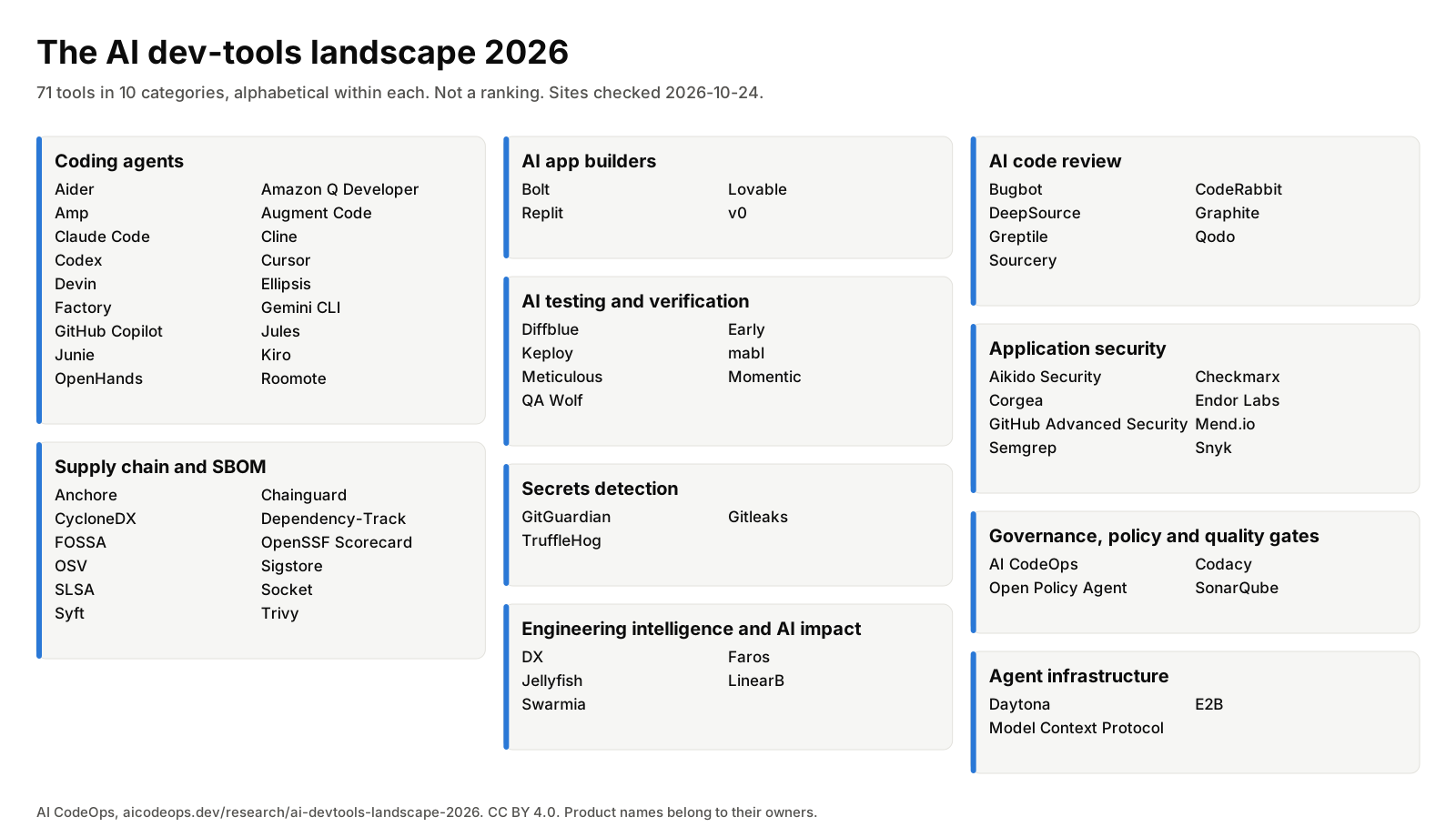
71 tools that software teams use to write, review, test, secure and govern code with AI, in 10 vendor-neutral categories. Every entry links to the tool's official site. Tools are alphabetical within each category: this is a map, not a ranking.
Last checked 2026-10-24. Free to reuse under CC BY 4.0. Download the list as CSV or open the map as an image.
Find a tool
Showing 71 of 71 tools.
Coding agents
Agents that write and change code from a task, in the editor, the terminal or the cloud.
- Aider
Open-source AI pair programming in the terminal.
- Amazon Q Developer
AWS's AI coding assistant for the IDE.
- Amp
A coding agent and development environment.
- Augment Code
Agentic software development for whole engineering organisations.
- Claude Code
Anthropic's agentic coding tool for the terminal and IDE.
- Cline
An open-source coding agent with plan and act modes.
- Codex
OpenAI's coding agent.
- Cursor
An AI code editor with agents you hand tasks to.
- Devin
An autonomous coding agent, with parallel cloud agents.
- Ellipsis
Managed cloud agents, defined as config files in your repository.
- Factory
Agents ("Droids") that automate coding, testing and deployment.
- Gemini CLI
Google's open-source AI agent for the terminal.
- GitHub Copilot
GitHub's AI assistant and coding agent, from the editor to pull requests.
- Jules
Google's asynchronous coding agent.
- Junie
JetBrains' AI coding agent.
- Kiro
An agentic coding tool that turns prompts into executable specs.
- OpenHands
An open-source platform for running AI coding agents.
- Roomote
A cloud coding agent that opens reviewable pull requests, hosted or self-hosted.
AI app builders
Build a working app or website from a plain-language description.
AI code review
Read pull requests and comment on bugs, security and style before a person merges.
- Bugbot
Cursor's AI code review for pull requests.
- CodeRabbit
AI code review, PR triage and change explanations.
- DeepSource
An AI code review platform.
- Graphite
A code review platform for teams on GitHub, with AI review.
- Greptile
AI code review with context from the whole codebase.
- Qodo
AI code review with codebase context, in the IDE and on pull requests.
- Sourcery
AI code review for human and agent-written code.
AI testing and verification
Generate, run and maintain tests, or check changes against real behaviour.
- Diffblue
A testing agent that writes and maintains unit tests.
- Early
Finds bugs and opens fix pull requests, with verification evidence.
- Keploy
Verifies changes in CI against recorded production API traffic.
- mabl
An agentic test automation platform.
- Meticulous
Generates and maintains visual frontend tests.
- Momentic
AI QA with tests written in plain English.
- QA Wolf
Writes and runs end-to-end tests for web and mobile apps.
Application security
Find and fix vulnerabilities in code, dependencies and configuration, often with AI-suggested fixes.
- Aikido Security
Code, cloud and runtime security in one platform.
- Checkmarx
Application security testing with AI agents.
- Corgea
Finds, triages and fixes vulnerabilities in code and packages.
- Endor Labs
Application security for AI-generated and human-written code.
- GitHub Advanced Security
Built-in, AI-powered security for GitHub repositories.
- Mend.io
Application security and AI security in one platform.
- Semgrep
AI-assisted SAST, SCA and secrets detection.
- Snyk
Secures code, AI agents and the apps they build.
Supply chain and SBOM
Know what your software is made of, where it came from, and whether it was tampered with.
- Anchore
SBOM-based software composition analysis and container scanning.
- Chainguard
Trusted open-source container images, libraries and VM images.
- CycloneDX
The OWASP bill of materials standard.
- Dependency-Track
An open-source OWASP platform for analysing SBOMs.
- FOSSA
SBOM generation, license compliance and vulnerability management.
- OpenSSF Scorecard
Checks open-source projects for risky practices.
- OSV
An open database of vulnerabilities in open-source packages.
- Sigstore
Signing and verifying software artifacts.
- SLSA
A framework of levels for build integrity and provenance.
- Socket
Detects and blocks malicious and risky dependencies.
- Syft
An open-source CLI that generates SBOMs from images and filesystems.
- Trivy
An open-source scanner for vulnerabilities, misconfigurations, secrets and SBOMs.
Secrets detection
Stop API keys, tokens and passwords from leaking through code and history.
- GitGuardian
Secrets and credential security.
- Gitleaks
An open-source scanner for secrets in git repositories.
- TruffleHog
Finds secrets and checks whether they are live.
Governance, policy and quality gates
Decide what may merge and ship, enforce it, and keep a record of why.
- AI CodeOps
Quality gates and human approval for AI-written changes, with signed evidence packs.
- Codacy
Code quality, security and AI coding policies in one place.
- Open Policy Agent
An open-source, general-purpose policy engine.
- SonarQube
Code quality and security analysis with quality gates.
Engineering intelligence and AI impact
Measure delivery, developer experience and what AI tools change.
- DX
Measures developer productivity, including the shift to AI.
- Faros
Tracks and governs token spend across AI coding agents.
- Jellyfish
A software engineering intelligence platform.
- LinearB
Engineering productivity metrics, including AI's effect on delivery.
- Swarmia
Engineering intelligence for software teams.
Agent infrastructure
Sandboxes and protocols that coding agents run on and connect through.
- Daytona
Secure sandboxes for running AI-generated code.
- E2B
Isolated cloud machines for AI agents.
- Model Context Protocol
An open protocol for connecting AI applications to tools and data.
The map
Embed the map
Paste this into your page, slides or docs. It shows the image with a link back here.
<a href="https://aicodeops.dev/research/ai-devtools-landscape-2026"><img src="https://aicodeops.dev/research/charts/ai-devtools-landscape-2026.svg" alt="The AI dev-tools landscape 2026: 71 AI developer tools in 10 categories" width="1600" loading="lazy" style="max-width:100%;height:auto"></a>
<p><a href="https://aicodeops.dev/research/ai-devtools-landscape-2026">The AI dev-tools landscape 2026</a> by <a href="https://aicodeops.dev/">AI CodeOps</a>, CC BY 4.0</p>
How we built it
- Categories by job, not by vendor. Each category is a job a team needs done: writing code, reviewing it, testing it, securing it, knowing what is in it, keeping secrets out of it, deciding what may ship, and measuring the effect. A tool sits where its own site says its main job is.
- Official sites only. Every link goes to the tool's own website or official repository. We opened each one on 2026-10-24. Where a site redirected to a new domain, we link the new one. Tools whose site now points to a different product were left out.
- Our own words. The one-line descriptions are ours, written from each tool's own site. They are not reviews.
- Names, not logos. Product names belong to their owners. We don't use logos.
- Our own product, once. AI CodeOps appears in one category, governance, policy and quality gates, because that is what it does: it puts AI-written changes behind quality gates and human approval and records how each change was made. It is not listed as a coding agent or a reviewer.
Many tools do more than one job. A coding agent may review code, and a security platform may generate SBOMs. We list each tool once. For how these pieces fit together in a delivery pipeline, read AI agents across the software lifecycle and What are quality gates?
Frequently asked questions
How did you choose the tools?
We listed tools that software teams use to write, review, test, secure and govern code with AI, plus the supply-chain and infrastructure tools that sit around them. Each one has an official website we opened on the date shown, and its own site describes it as doing what its category says.
Is this a ranking?
No. Tools are listed alphabetically within each category. Being listed is not an endorsement, and not being listed is not a judgement.
Our tool is missing or in the wrong category. How do we fix it?
Email [email protected] with the tool's official site and the category you think fits. We add tools that match a category and re-check every link when we update the map.
Can I use the map in my article or talk?
Yes. The map and the list are licensed CC BY 4.0: use them anywhere, with a link back to this page. The embed code below shows the image with that link.
Cite this
AI CodeOps (2026). The AI dev-tools landscape 2026. https://aicodeops.dev/research/ai-devtools-landscape-2026
The data and charts on this page are licensed CC BY 4.0: reuse them anywhere, with a link back to this page.